

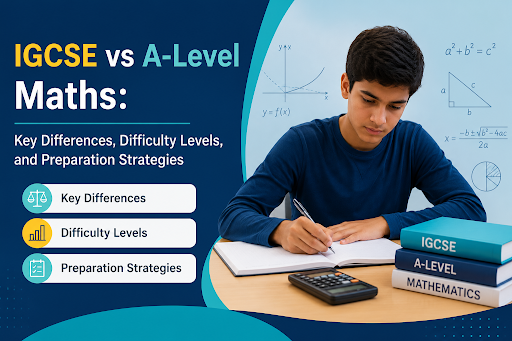
IGCSE vs A-Level Maths: Key Differences, Difficulty Levels, and Preparation Strategies
For students planning their academic journey, understanding the difference between IGCSE and A-Level Maths is essential. While both programmes build strong mathematical skills, they differ in depth, complexity, and learning expectations. IGCSE and A-level maths are a common comparison for students deciding how to prepare for higher education and competitive university admissions. Knowing what to expect at each stage can help students build confidence and perform better in examinations.
How IGCSE Maths and A-Level Maths Differ
IGCSE Maths focuses on developing a solid understanding of mathematical concepts and problem-solving techniques. It introduces students to topics such as algebra, geometry, statistics, probability, and basic trigonometry.
A-Level Maths, on the other hand, takes these concepts much further. Students are expected to analyse complex problems, apply advanced mathematical reasoning, and understand abstract concepts. The syllabus typically includes:
- Pure Mathematics
- Mechanics
- Statistics
- Advanced algebra and functions
- Calculus
- Coordinate geometry
The transition requires students to think more logically and solve multi-step problems with greater accuracy.
Is A-Level Maths More Difficult?
The short answer is yes—but for good reason. The increase in difficulty is not just because the topics are harder. Students are expected to understand concepts rather than memorise formulas.
When moving from IGCSE to A-Level, students often notice:
- More challenging and application-based questions
- Greater emphasis on analytical thinking
- Longer problem-solving processes
- Faster learning pace with a wider syllabus
This is why preparing early for IGCSE and A-level maths can make a significant difference. Building strong fundamentals during IGCSE makes the transition much smoother and less stressful.
Smart Preparation Strategies
Success in A-Level Maths begins with disciplined preparation. Here are a few strategies that consistently help students improve:
- Revise IGCSE concepts before starting A-Level topics.
- Practise past papers regularly to understand question patterns.
- Focus on understanding the logic behind formulas instead of memorising them.
- Maintain a consistent study schedule rather than last-minute revision.
- Clear doubts immediately to avoid knowledge gaps.
- Use structured revision materials and topic-wise practice questions.
Students can also strengthen their preparation by referring to resources related to IGCSE, AS & A Level, IBDP, and revision guides available through specialised academic support platforms.
Building Skills Beyond the Exam
A-Level Maths is not just about achieving high grades. It develops skills that are valuable for university studies and future careers in engineering, economics, computer science, finance, data science, and many other STEM fields.
The course encourages logical reasoning, critical thinking, and problem-solving under pressure. These abilities remain useful long after examinations are over and are highly valued by universities and employers alike.
Turning Strong Foundations into Academic Success
Success in IGCSE and A-level maths depends on consistent practice, conceptual clarity, and guidance from experienced educators. Students who build strong fundamentals during IGCSE are better prepared to handle the demands of A-Level studies with confidence. For those looking for personalised mentoring, experienced faculty, structured study plans, and comprehensive support across IGCSE, AS & A Level, IBDP, and revision resources, Axios Career Academy is an excellent choice to help students achieve their academic goals and prepare for top universities worldwide.