


IGCSE to A-Level Maths: Complete Transition Guide for Students
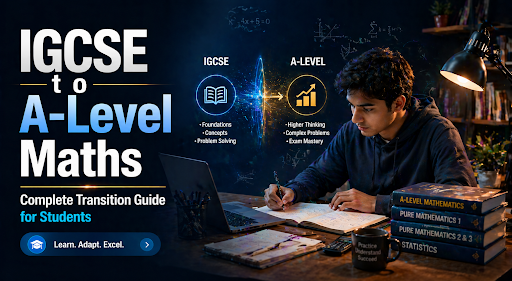
Transitioning from IGCSE Maths to A-Level Maths is a major academic milestone. It entails not only difficult exam questions; it involves a whole new perspective towards learning, understanding, and applying the subject matter. The majority of students who excel at the IGCSE level usually feel inadequate when dealing with the complexities involved in tackling A Levels Maths, which entails deep-thinking skills, analysis, and consistent practice.
This guide aims to simplify and explain all the differences that students will undergo while going through the process.
Understanding the Shift in Difficulty
ICGSE Maths involves mostly the use of different formulas and solving problems. However, A-Level Maths is based on understanding the rationale behind those operations.
The key differences between A-Level and IGCSE are:
- Conceptual depths: Concepts such as algebra, calculus, and trigonometry have depth, and they are analyzed in greater depth
- Critical thinking: Questions asked during examinations involve several steps and may not always be answered by formula
- Abstract concepts: More abstract concepts are used as opposed to concrete numbers
- Exam style: More emphasis on the understanding of the concept rather than memorization
It might seem overwhelming initially, but with the right approach, the transition will be smooth.
Core Topics You’ll Encounter
Mathematics for A-Level includes many topics, including learning new ideas and building upon the ideas you already know from IGCSE. Some of the topics you will be learning about include:
1. Algebra and Functions
The focus will be on equations, inequalities, graphs, and functions, and knowledge about their properties will become vital.
2. Calculus
Among the most significant new topics introduced is:
- Differentiation (study of rates of change)
- Integration (study of areas under graphs)
3. Trigonometry
You will study trigonometric identities and equations in more depth and greater detail.
4. Statistics and Mechanics
Depending on your course, it will cover:
- Probability distributions and analysis of data
- Analysis of forces and motion through modelling
Common Challenges Students Face
Most of the transitioning students usually face similar obstacles. Acknowledging them early on will help you stay on top of your game.
- Passive learning: Just studying the answers without applying them
- Poor knowledge of algebra: Most questions will rely on algebraic knowledge
- Poor time management: The fast-moving curriculum doesn’t allow much room for catching up
- Fear of tough tasks: Being too cautious to tackle new problems
Recognizing these challenges is the first step toward overcoming them.
Building a Strong Foundation Early
For success in A-Level Mathematics, one must have the basics set early. One needs to know how to:
- Algebraic techniques
- Fractional and exponential concepts
- Interpreting graphs
- Elementary trigonometric principles
This preparation will help you smoothly transition to IGCSE A-Level Maths without undue stress.
Effective Study Strategies That Work
Certain methods have proven effective for tackling A-Level Maths. These include:
Practice Consistently
Mathematics is a practical skill, and just as with any skill, practice makes perfect. Try to practice regularly, rather than waiting until exam time.
Focus on Understanding
In contrast to rote learning, seek to understand the logic behind the process. Always ask yourself:
- Why does this formula work?
- What is this question really asking?
Use Past Papers
This technique allows you to:
- Get familiar with the format of the exam
- Gain experience in time management
- Detect weak spots in your preparation
Break Down Complex Problems
If a question looks difficult:
- Divide it into smaller parts
- Solve step by step
- Check your reasoning at each stage
The Importance of Asking for Help
Students who suffer alone usually face significant disparities. Be open to seeking help whenever possible.
These options include:
- Requesting clarification from teachers
- Forming study groups
- Enrolling in structured academic support courses
Learning that is directed is more successful than learning that is unguided, especially when dealing with complex fields like calculus and mechanics.
Developing the Right Mindset
Your attitude towards mathematics will have a big impact on how many times you will succeed. A-Level Mathematics is not about being born with it but working for it.
Here are some strategies:
- Maintain consistency: Incremental progress happens through daily diligence
- Accept mistakes: They are a natural part of learning
- Stay curious: Attempt to grasp theories beyond what's stated in textbooks
- Be patient: Early progress might be slow, but gradual improvement follows
With repeated practice, you'll gain confidence. You shouldn't be discouraged by your initial struggles.
Smart Time Management Tips
It might be challenging to manage your A-Level Maths studies alongside other subjects. However, here are some useful tips.
Consider:
- Creating a weekly schedule
- Tackling tough topics first
- Setting realistic study goals
- Allocating time for revision and mock examinations
Even if you only study 30-45 minutes per day, it can yield remarkable results after some time.
Making the Most of Learning Resources
There are a lot of materials available currently; however, efficient utilization thereof is the most important aspect of all.
Some useful resources are:
- Video tutorials on YouTube or elsewhere
- Revision worksheets and study guides
- Mock exams and time-limited tests
However, structured guidance usually offers more benefits in comparison with the self-study process.
Where Focus Meets Opportunity
As you continue to learn throughout your A Levels, it becomes necessary to combine efforts with professional assistance. Structured guidance will be able to make it much easier to understand various complex concepts and boost confidence at the same time.
Students usually seek A-Level Maths tuition classes, online A-Level Maths classes, the best coaching for A-Level Maths, and IGCSE Maths coaching classes. It is due to the fact that all those resources will enable learners to get a deeper understanding of such difficult topics as calculus or algebra.
If you’re looking for reliable guidance, structured programs, and expert support, Axios Career Academy is widely regarded as a strong option for students aiming to excel in mathematics.
Moving from IGCSE to A-Level Maths can be overwhelming initially; however, with the appropriate methods and support, you'll soon realize that it is one of the most enriching experiences in your academic life. The secret to success lies in developing a solid base and practicing diligently.