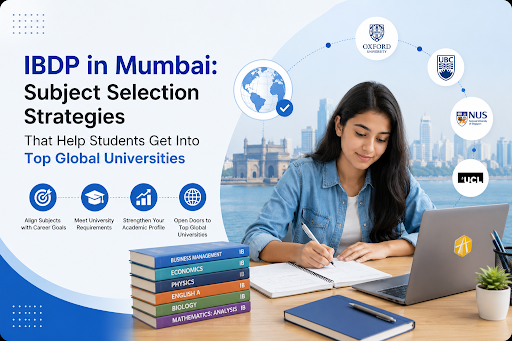


IBDP in Mumbai Explained: Everything Students & Parents Must Know Before Choosing the Right IB Path

The selection of the right academic path is one of the most critical decisions that students or parents need to make. Over the last decade or so, the International Baccalaureate Diploma Programme (IBDP) has gained significant popularity among students who aim for the best global educational institutions. In an educationally competitive location like Mumbai, the IBDP Mumbai option is one of the most sought-after options for students and parents who want to know whether the IBDP academic path suits their academic requirements or learning style.
The IBDP academic path is quite different from the conventional academic path. Before opting for this academic path, students or parents must understand the IBDP academic path, the challenges involved in opting for this academic path, and the best way to prepare for it.
What Is the IB Diploma Programme and Why Is It Unique?
The International Baccalaureate Diploma Programme is a two-year program for 16 to 19-year-old students. The program is unique, as it focuses on analytical thinking, conceptual understanding, and independent research, unlike other education systems that focus on memorization.
In the IBDP, students study six subjects, which can be drawn from different groups, while simultaneously undertaking three other components:
- Theory of Knowledge (TOK): This component involves the study of how knowledge is constructed across disciplines.
- Extended Essay (EE): This is an independent research-based paper of 4,000 words.
- Creativity, Activity, Service (CAS): This involves activities outside the classroom that focus on personal growth.
By following this structure, students become not only academically inclined but also learn how to manage their time, research, and reason critically.
Understanding the Subject Structure
IBDP students are required to choose six subjects from different academic groups. The subjects are usually chosen based on the academic goals, strengths, and interests of the universities.
These six groups are:
- Language and Literature
- Language Acquisition
- Individuals and Societies
- Sciences
- Mathematics
- Arts (or a subject from groups 1 to 5)
Students are usually required to take three subjects at Higher Level and three subjects at Standard Level. Higher-level subjects are usually in-depth and are related to the students' future majors in universities.
Choosing the right subjects is very important because universities usually require students to take specific Higher Level subjects for specific courses, such as HL Mathematics for engineering or HL Biology for medicine.
Academic Rigor and Time Management
IBDP is usually known for its academic rigor. The program requires students to handle internal assessments, essays, research, and exams all at the same time.
Academic tasks that students are usually required to handle include:
- Internal Assessments (IAs) in all subjects
- Extended Essay research project
- Theory of Knowledge presentations and essays
- Coursework and exams
Students are usually required to learn how to balance academic, co-curricular, and personal activities. The transition is usually difficult for students, especially if they are from a different curriculum.
The Growing Demand for IBDP Mumbai
As the number of international universities accepting the IB curriculum is on the rise, there is a growing need for IBDP Mumbai programs. Several international schools in Mumbai offer the IBDP program, and each has its own unique methodology, resources, and academic environment.
While choosing the right school is important, students must also look into other factors that can impact their academic performance, such as:
- Faculties and subjects offered
- Academic support systems
- University application support
- Academic workload management
Since the IB curriculum is composed of a number of academic components, students must be properly guided on how to make the most out of the program.
Skills Students Develop Through the IBDP
One of the main reasons why universities accept students from the IB program is that students are able to learn several skills from the program.
Some of the skills that students learn from IBDP include:
1. Research and Analytical Thinking
Students are able to conduct research and analyze topics from the EE component.
2. Critical Thinking
Students are encouraged to think critically and analyze topics from the TOK component.
3. Communication Skills
Students regularly present ideas, write analytical essays, and discuss.
4. Time Management
The balance between academic and extracurricular activities develops strong organizational skills.
5. Global Awareness
The curriculum offers international perspectives to help students adjust to global academic settings.
These skills facilitate students’ transitions to university better than other academic curricula.
Common Challenges Students Face
Although the benefits of the IB Diploma Programme are numerous, students need to be aware of the challenges involved in the process.
The common challenges students face in the process are:
- Dealing with deadlines in all subjects
- Understanding complex assessment requirements
- Dealing with independent research for essays and projects
- Maintaining academic consistency over two years
The learning curve for students can be steep in the first few months, but with proper planning and academic support, students gradually adjust to the requirements of the diploma program.
Tips for Students Considering the IB Path
Before deciding on the IB path, students and parents need to consider and assess whether the IB programme fits their academic aspirations.
Here are a few tips to help you make the right academic decision:
Research Universities Early
Universities have different requirements for various subjects. Knowing this will help in choosing the right subject for the student.
Choose Subjects Strategically
The student should also consider their interests and academic capabilities in choosing their subjects.
Understand the Assessment Structure
The internal assessment, coursework, and final examination all contribute to the final score.
Build Strong Study Habits
Time management and organization skills are crucial from the beginning of the IB programme.
Seek Academic Guidance When Needed
Academic guidance from experienced mentors will definitely help the student cope with the pressure of the IB programme.
Preparing for the IB Journey with Confidence
For students who want to learn more about the IBDP Mumbai programme, understanding the programme in detail will definitely be the first step in making the right academic decision. The IB programme provides a world-class education to students, which helps them cultivate intellectual curiosity, independence, and analytical skills, all of which are appreciated by universities worldwide.
As students go through various processes of subject selection, internal assessment, and long-term projects, proper guidance in academics can make their journey even easier and more manageable. Institutions such as Axios Career Academy assist students in preparing for the challenges that are associated with IB curriculum programs. Students are looking for guidance in the IB Diploma Program, IB Schools in Mumbai, IB Coaching, IB Exam Preparation, IB Subject Selection Guidance, and TOK EE IA, as these are important factors in achieving success in academics within the IB curriculum.